From Zhuji to Lespéra
How pearls are born.
From the quiet waters of Zhuji, China, to a single, chosen pearl. No factory. No shortcuts. Just nature, patience, and an eye for character.
The Source
Zhuji, Zhejiang.
Zhuji sits in the north of Zhejiang Province, in eastern China — a region of slow rivers, lake networks, and a long, humid growing season. The town has supplied more than 90% of the world’s freshwater pearls for decades, not because of marketing, but because the water, the craft, and the patience are all there.
The pearl trade in Zhuji is not a factory floor. It is a network of family farms, small workshops, and market stalls where farmers raise mussels, harvest pearls, sort them by hand, and sell them to buyers who know that no two pearls are ever the same.
This is where every Lespéra pearl begins.
Because we select every pearl directly at the source — working with the same farms and small workshops we know personally — each piece carries the kind of quality and character that usually passes through brokers, showrooms, and markups before it reaches you. No middleman. No inflated story. Just the pearl, chosen by hand.
A Recent Visit
This summer, at the source.
This summer, I traveled back to the region where Lespéra’s pearls come from. I walked the farms, watched the mussels being lifted from the water, and spent hours at the market sorting through harvests with a friend who has lived and worked there for twenty years.
It is one thing to understand pearl farming in theory. It is another to hold a freshly harvested pearl in your hand and see how the light moves across it — or to notice how a farmer sets aside one mussel because the nacre feels different under the thumb.
One minute at the source.
Filmed on the trip — the water the mussels grow in, the harvest, the pearl market where strands are traded by the kilo, and the quiet bench work of drilling and stringing each pearl by hand. Nothing staged; this is simply what it looks like when jewelry begins in a place, with people, rather than in a catalog.
Filmed on location, Zhuji · Summer 2026
The Process
From water to light.
There is no machine that can judge a pearl. The glow, the weight, the softness of the skin — these are read by hand.
The mussels.
Freshwater pearls grow inside mussels raised in the clean, slow-moving lakes and rivers of Zhuji. The same town has supplied more than 90% of the world’s freshwater pearls for decades, and the craft there is passed down through families, not spreadsheets.
The seed.
A tiny piece of donor mantle tissue is gently inserted into the mussel. This tissue is what the mussel will coat in nacre. The shape, placement, and health of the mussel all influence what the pearl will become.
The wait.
The mussels are lowered back into the water in mesh nets and baskets. They are tended through seasons of sunlight, rain, and cool water. Inside each shell, the nacre builds in thin, overlapping layers, giving the pearl its depth and glow.
The harvest.
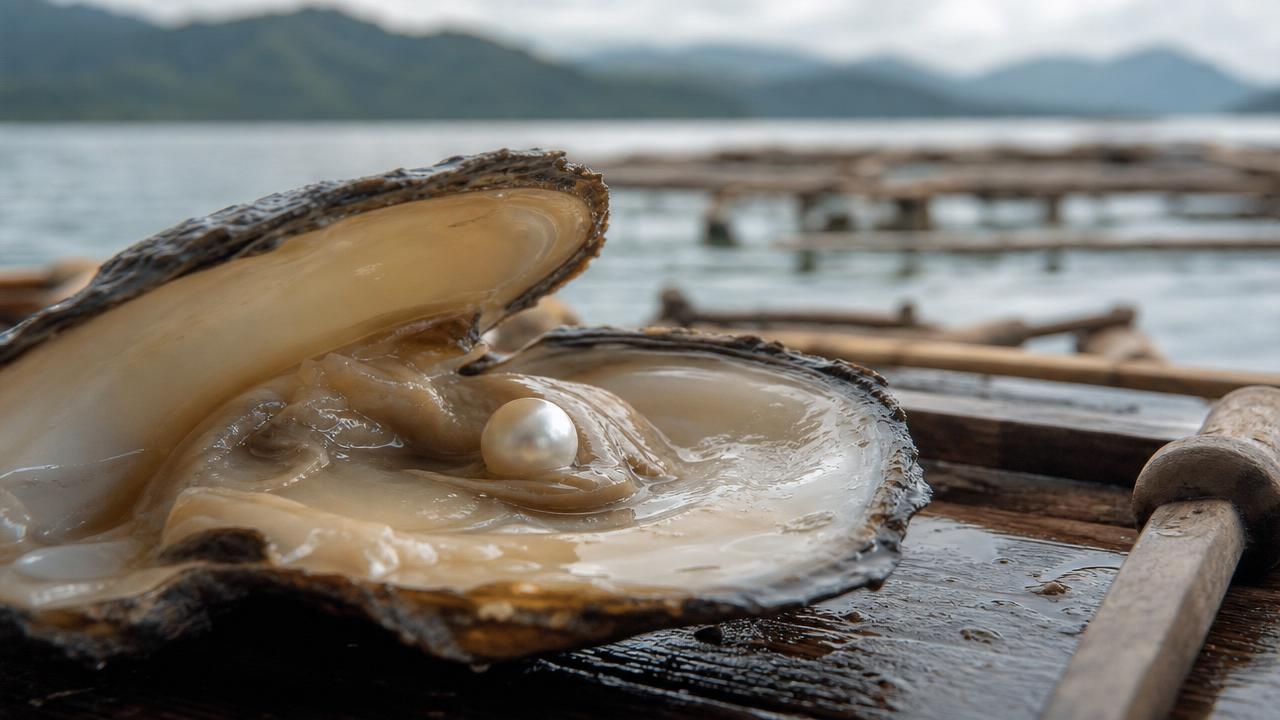
When the time is right, the mussels are lifted, opened, and harvested. Some yield one perfect pearl. Others yield several. Each is washed, sorted, and then chosen — or set aside — by hand.
Selection
Chosen by eye, not by algorithm.
After harvest, pearls are sorted by size, shape, color, and surface. But the final decision — which pearls become Lespéra pieces — is made in person. We look for lustre first: the mirror-like quality that lets a pearl hold light rather than simply reflect it.
Then comes shape. Round pearls are rare and prized, but baroque pearls have their own character — an organic silhouette that no mold could reproduce. Color, size, and surface cleanliness follow, each pearl judged as a whole rather than a checklist.
Once selected, each pearl is paired with a setting designed to honor it. Simple, quiet, and strong enough for daily wear. No oversized logo. No unnecessary detail. Just the pearl, exactly as it is.
A Local Legend
Zhuji is the hometown of Xi Shi.
Xi Shi, one of the four great beauties of ancient China, was born near Zhuji — and local legend says her beauty was as soft and luminous as a pearl. Perhaps it is no coincidence that the hometown of the most beautiful woman in ancient China also produces pearls celebrated as the most beautiful in the world.
For centuries, the region has been associated with grace, restraint, and the kind of presence that does not need to raise its voice. That quiet, enduring elegance is exactly what Lespéra tries to capture. A pearl is not loud. It does not demand attention. It simply holds it — the way a woman who knows herself can walk into a room and change it without saying a word.
“西施越溪女,出自苎萝山。
秀色掩今古,荷花羞玉颜。”
“艳色天下重,西施宁久微。
朝为越溪女,暮作吴宫妃。”
The Collection
See what the water made.
Each collection is hand-selected in small quantities, because every pearl is naturally unique. Future editions may feature the same design, but never exactly the same pearls.
Shop the Collection